
License management
See every open source license your products ship, decide once which ones your organization accepts, and hand procurement a software bill of materials for any repository.
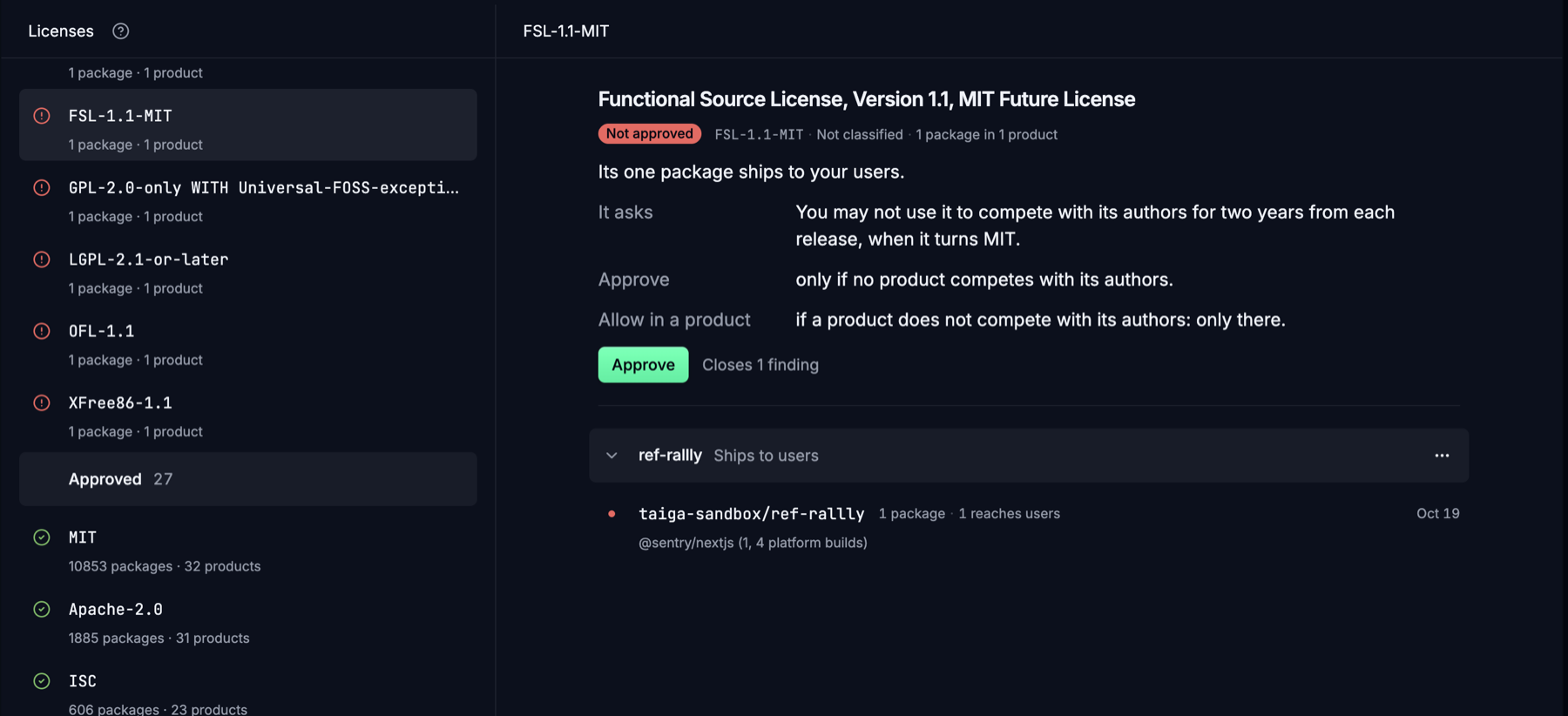
Legal and security reviewers ask two questions of every codebase: which open source licenses does it ship, and has the organization approved them all. The answer is usually a spreadsheet built the week before an audit.
Every maintenance sweep now records each package a repository uses, its license, and whether it ships to users or only builds and tests. Your organization keeps one approved list, starting from a default made for regulated enterprises. A license outside it becomes a finding: approve it once for the whole organization, or allow it in one product with a reason.
The list binds Taiga's own work too. The planner checks the license of every package it would add, and picks another or asks you when nothing else will do.
When a vendor review asks for proof, each repository downloads as a CycloneDX SBOM, with the third-party notices beside it.
A GPL package that arrives through a charting library shows the library that brings it in, and the decision waiting on it.
License review becomes a decision you make once, not an audit you prepare for.
Every change, dated the day it shipped.
Dated the day they shipped, newest first.